The whole catalog stays open
That is the first wonder: when the path is not measured, the electron does not behave as if only one possibility exists. Reality seems to hold every possibility open at once — the full catalog, nothing yet chosen.
THE QUANTUM SELF PROJECT
At the intersection of science and the mystery of being human.
A psychiatrist-led exploration of consciousness, the brain, and the extraordinary questions that remain unanswered — a clear-eyed exploration of mental illness, psychopharmacology, and the emerging science of psychedelics, with clinical evidence as the compass.
Prefer email? thequantumselfproject@gmail.com — I read every note that comes in.
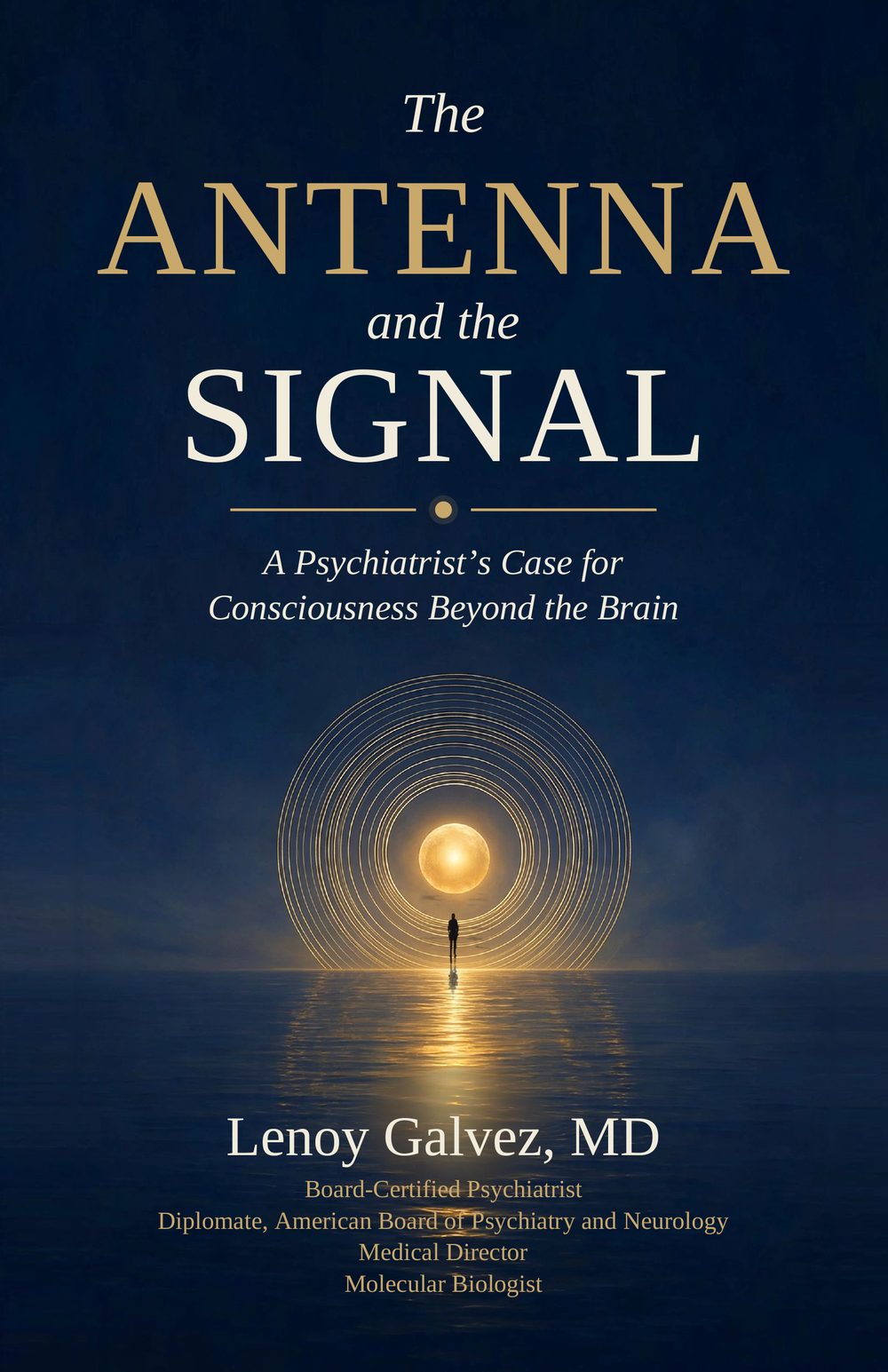
Now available on Amazon
Paperback $19.99 · Kindle $9.99 · in English and Spanish · Audiobook on Spotify
THE BOOK
What if the brain doesn't create consciousness — but receives it?
Board-certified psychiatrist Dr. Lenoy Galvez takes you inside the greatest mystery in science. Drawing on quantum physics, near-death-experience research, psychedelic science, and nearly two decades of psychiatric practice, he makes the provocative case: the brain is not the generator of consciousness but its antenna — a receiver, filter, and tuner for a signal that may exist beyond the body.
From the double-slit experiment to the dying brain's final gamma surge, from Plato's cave to the frontiers of neuroscience — eight chapters, twenty-eight illustrations, and the one question materialism can't answer. The signal is already broadcasting. It's time to tune in.
Get the free excerpt — the Preface, Introduction, and Chapter 1 — and find the book live on Amazon.
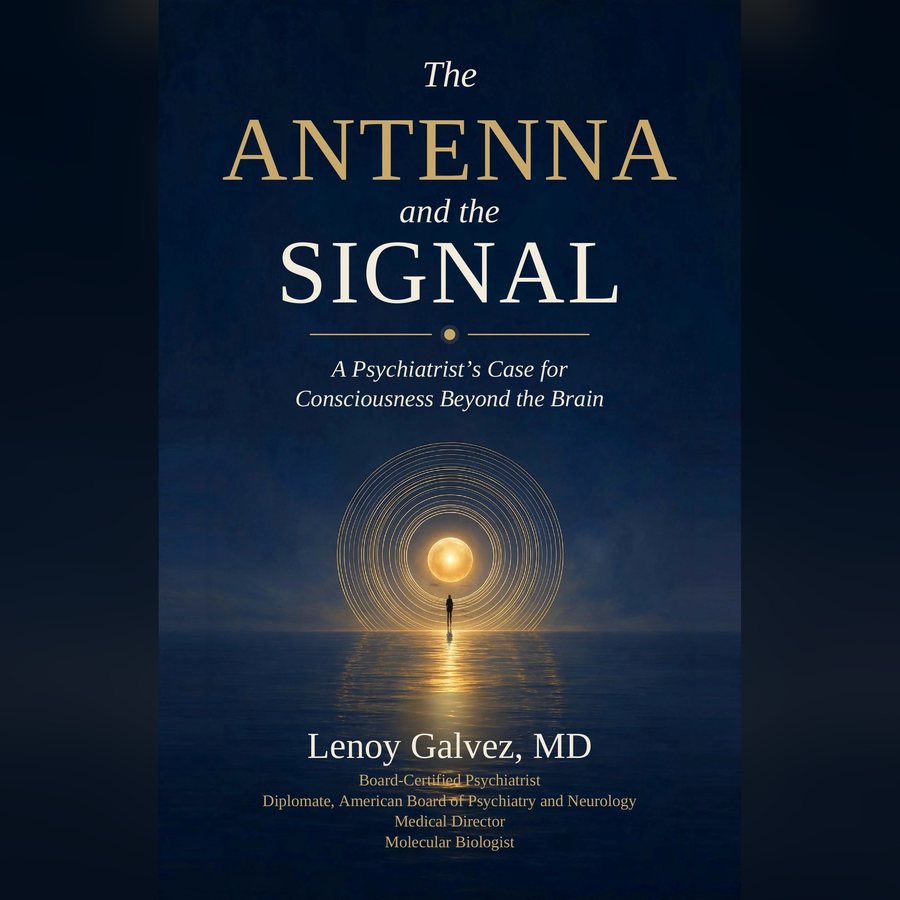
THE AUDIOBOOK
The whole book, read aloud: a psychiatrist's case that the brain is an antenna and consciousness is the signal — all eight chapters, the preface, and the appendix, unabridged and ready wherever you listen.
THE WORKBOOK
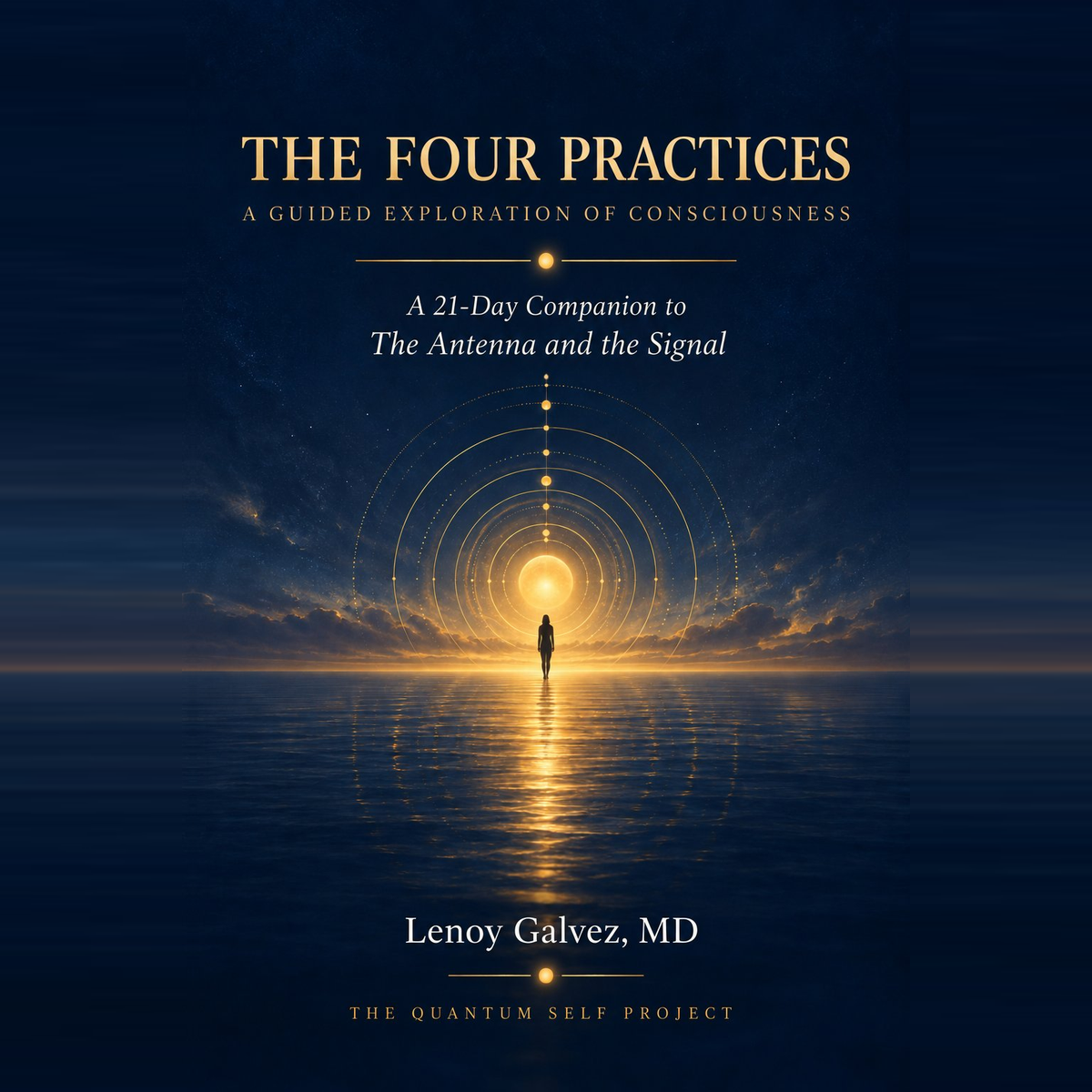
A Guided Exploration of Consciousness — a 21-day companion to The Antenna and the Signal
The book made a case. This workbook invites you to look for yourself. Twenty-one days of short readings, simple practices, and one deeper question a day — including a “From the Psychiatrist's Chair” reflection in every module. Fillable PDF, yours to keep.
Or start free: the appendix narration audio is a free download. Free audio bonus
Also available in Spanish: Las Cuatro Prácticas.
Explore the workbook — what’s inside, and a full sample day →
01 / YOUR GUIDE
Questions or ideas? Reach me at thequantumselfproject@gmail.com — I read every note that comes in.
“Quantum physics and consciousness” has been part of Dr. Galvez’s teaching since his psychiatry residency—not a trend added after the fact.
Before there was a book, there was a story his family could not explain. When Dr. Galvez was one year old, his grandfather José Deogracio González suffered a heart attack in Cuba — and came back describing things no one around him could account for: leaving his body and watching the doctors work on him, a tunnel of light with other travelers beside him, his whole life lived again from inside the people he had loved, and a baby on the other side of the world — his grandson — whom he saw in the moment he chose to return.
That baby grew up to be a psychiatrist. Nearly two decades in emergency rooms and inpatient units have put Dr. Galvez across the table from people describing experiences the standard model of the brain struggles to explain. His grandfather’s story never left him. It is the reason a psychiatrist went looking.
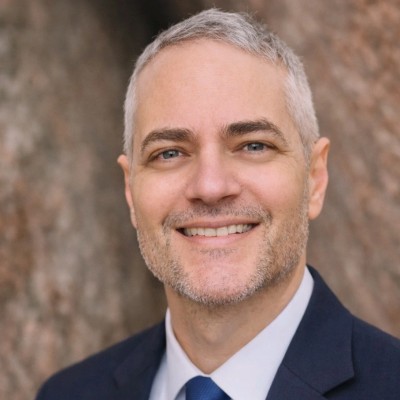
Dr. Lenoy Galvez, MD,LinkedIn is a Board-Certified Psychiatrist, Diplomate of the American Board of Psychiatry and Neurology, Medical Director, and Molecular Biologist with more than 18 years of clinical and leadership experience. His work spans inpatient, outpatient, geriatric, consultation-liaison, and emergency psychiatry, with particular experience in complex and treatment-resistant conditions.
His approach integrates evidence-based psychopharmacology with psychotherapy and care tailored to each patient’s clinical profile, culture, and lived experience. He is committed to thoughtful, individualized care for people from diverse backgrounds and is fluent in English and Spanish.
Dr. Galvez completed his general psychiatry residency at New York Medical College at Westchester Medical Center, where he served as chief medical resident. He earned his MD with high honors from Ross University School of Medicine and his B.S. in molecular biology with a minor in psychology, summa cum laude, from the University of South Florida.
His professional work also includes resident and medical-student education and research on novel psychiatric therapies at the Nathan Kline Institute for Psychiatric Research. His clinical and academic honors include the Clinical Excellence in Psychiatry Award and Psychiatry Residency Intern of the Year Award.
Diplomate, American Board of Psychiatry and Neurology
Medical Director and board-certified psychiatrist
Faculty educator for psychiatric residents and medical students
Fluent in English and Spanish
The views expressed in The Quantum Self Project are Dr. Galvez's own and do not represent his employer or any affiliated institution.
CHOOSE YOUR WAY IN
Follow the evidence through psychiatric medications, mental-health conditions, treatments, psychedelic research, consciousness, and quantum questions—or begin with an intuition and see which trail it opens.
THE INFORMATION LIBRARY
Move from practical clinical guides to the hardest questions about mind, matter, and experience.
INTERACTIVE EXPERIMENT
Imagine sending tiny particles, called electrons, toward a wall with two narrow openings. Behind the wall is a screen that records where each electron lands. If electrons behaved like tiny marbles, they would pass through one opening or the other and gradually form two piles. Instead, when no detector records which opening each electron used, the landing marks slowly form a pattern of many stripes — the kind of pattern waves make when they pass through both openings and overlap.
OBSERVER OFF · PATH UNKNOWN
Observer off. Paths are indistinguishable, so detections build an interference pattern.
That is the first wonder: when the path is not measured, the electron does not behave as if only one possibility exists. Reality seems to hold every possibility open at once — the full catalog, nothing yet chosen.
Place a detector at the openings so the path can be recorded — “watching” here means a detector recording the path, not a person standing nearby. The stripes disappear, and the electrons land in the two ordinary groups common sense expected. One possibility has become the actual result.
Think of Spotify. It already holds more than a hundred million songs; pressing play does not create the song you hear — it selects it. And you never hear the whole catalog. Your history, habits and taste narrow that vastness into a playlist: the small part of the whole that becomes your evening.
That, in this book’s lens, is life. Unobserved, reality is the full catalog — every possibility present at once. When an observer enters, one track plays. The Antenna and the Signal asks whether the observer’s filter — biology, history, conditioning, everything that formed the person — helps determine which possibility becomes the life actually experienced. You do not experience everything. You experience your playlist. And if the filter changes, perhaps a different track can play. One boundary stays explicit: physics has not proved that conditioning chooses quantum outcomes; physicists call the selection random. The filter is the book’s interpretation — the lens that makes the experiment feel personally important rather than merely strange.
ENTANGLEMENT, EXPLAINED
Some connections do not fade with distance. In 1935, Albert Einstein — who helped create quantum theory and never made peace with it — pointed to the strangest case: two particles that have interacted can be separated, even by light-years, and measuring one seems to settle the other instantly into its correlated state. He called it "spooky action at a distance" and took it as proof the theory had to be incomplete. The experiments said otherwise.
ENTANGLED PAIR · NOT YET MEASURED
Entangled pair ready. No measurement has been made yet.
Each result is random — you cannot choose it, steer it, or use it to send a message. What you can do is compare the two sides afterward, and find they were never independent.
Create two particles in a shared event and let them fly in opposite directions. Look at either one alone and its result seems random. But compare many pairs, and the two sides answer each other too faithfully for each particle to have simply carried private instructions from the start. Together, they keep behaving as one system.
Measure one particle, here and now — and the state of its distant partner is settled in the same instant, however many light-years lie between them. Nothing travels across the gap; no signal crosses the dark. It is as if distance describes where the particles are, but not the whole of how they are connected.
Einstein hoped something was missing — hidden variables that would restore a sane, local universe once found. In 1964, John Bell showed that any theory both local and realistic must obey certain statistical limits — and that quantum mechanics predicted results breaking them. Alain Aspect's experiments in the early 1980s, the loophole-free tests of 2015, and the 2022 Nobel Prize to Aspect, John Clauser, and Anton Zeilinger settled the argument as close to definitively as science gets: the correlations are real, and no local theory can explain them.
Entanglement is not a telephone: no one can choose a result, force a distant particle to carry a message, or send information faster than light; the connection appears when records from both sides are compared. But the wonder survives the boundary. At the deepest level physics can test, the universe is not a collection of separate billiard balls — it behaves, in some respects, like a single indivisible whole. Physics stops at the correlations. This book's lens hears an older human claim inside them — Thich Nhat Hanh's "interbeing," the Upanishads' "thou art that": separation may be an appearance, and connection the deeper fact. That last step is a lens, not a lab result — but after entanglement, it is harder to call it mere poetry.
THE DEEP QUESTION
Psychiatry usually starts with chemistry. This project starts one level deeper — with the mystery chemistry can't touch.
01
Take an apple tree and zoom in past what any eye can see: molecules, atoms, the nucleus, quarks — and then, if string theory is right, the trail ends at impossibly tiny filaments of pure vibration. Everything solid is, at bottom, a kind of music.
02
Science can map every neuron that fires when you see red — and still cannot say why red feels like anything. Consciousness is the one fact you know directly, and the one fact physics cannot derive from matter.
03
A radio doesn't create the music; it receives it, filters it, tunes it. What if the brain works the same way — and mental illness, psychedelics, even anesthesia are stories about tuning, not just chemistry? Interference is not identity. Radios can be retuned.
This is the thread my book follows to its end — The Antenna and the Signal, now live on Amazon.
THE MODEL
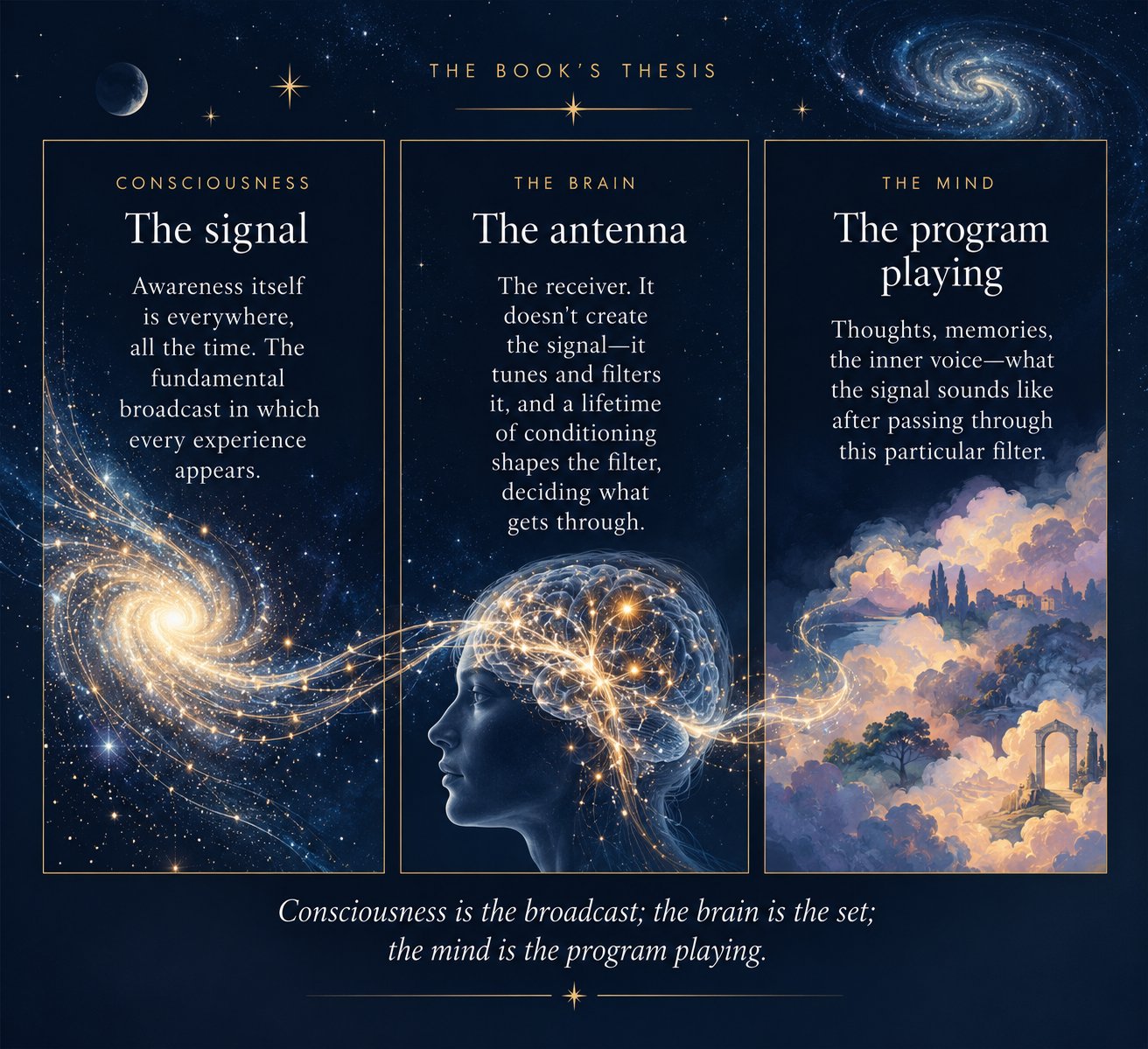
Everything here — the book, the videos, the practices — runs on three precisely used words.
CONSCIOUSNESS
Awareness itself — the presence in which every experience appears. Formless, timeless. What you might call your soul or spirit. It doesn't come from the brain. The brain tunes into it.
BRAIN
The receiver: wiring and chemistry that shape the signal into experience, the way a TV set shapes a broadcast into a picture. Damage the set and the picture changes — but the broadcast goes on.
MIND
Your personal inner life: thoughts, memories, the inner voice — and a lifetime of conditioning. It's what the signal sounds like after passing through your particular filter.
Rumination is the program stuck on replay — the same thoughts looping, each replay feeling urgent and true. The shift this project is built on: you are not the program. You are the awareness it's playing in.
A psychiatrist's caution: these are gentle practices, not treatments. If rumination is running your life, that's what professionals are for. This page is education, not care.
WATCH
Short videos on consciousness, psychiatry, and the science at the edge of the mind — they play right here, no account or app needed.
FEATURED
Told by the author himself — the near-death experience that started everything, and the reason the book exists.
The announcement — The Antenna and the Signal is out now on Amazon, paperback and Kindle, in English and Spanish.
The man with a fluid-filled skull, the blind woman who saw her wedding ring, and the dying brain's final surge.
Tap the + to watch the reels.
Told by the author himself — the near-death experience that started everything, and the reason the book exists.
The man with a fluid-filled skull, the blind woman who saw her wedding ring, and the dying brain's final surge.
Terminal lucidity, the acquired savant, and shared-death experiences — three mysteries for the antenna hypothesis.
String theory says every particle is a different note on the same vibrating strings — a cosmic symphony.
A Louisiana toddler described a WWII plane crash — the carrier, the pilot's name, Iwo Jima. The details he gave matched military records.
Sixty volunteers, four hundred DMT doses — and strangers who never met described being greeted by the same impossible beings.
From four billion miles away, Earth is a single pixel — and everyone you love lived their entire life on that mote of dust.
Brain injuries that unlocked genius — what if brilliance isn't built, but unleashed when the brain's filters break?
Her heart was stopped and her brain went flat — yet she watched her own brain surgery from above and described the bone saw.
More shorts on the YouTube channel — new ones regularly.
STORIES
Every reel begins with a real person whose case the standard story can't hold — the woman who can smell Parkinson's, the man with almost no brain, the girl who led investigators to a house she'd never seen. Read their stories in full, at reading pace.
TREATMENTS, EXPLAINED
Short, honest explainers — what each treatment is, what it's used for, and what it's actually like.
Tap the + next to any topic to read more.
Focused magnetic pulses stimulate areas of the brain involved in mood. No surgery, no anesthesia — you sit in a chair, awake, for about 20 to 40 minutes a session.
Mainly depression that hasn't responded to medication; also used for OCD and other conditions.
Most people feel a tapping sensation on the scalp. You can drive yourself home afterward.
Ketamine given as an IV infusion, or as a nasal spray called esketamine, can lift severe depression in hours rather than weeks.
Depression that hasn't responded to other treatments, and situations where waiting weeks is not an option.
The infusion lasts under an hour. Some people feel dreamlike or detached during it; that fades the same day. It's always given in a clinic, with monitoring throughout.
Brief, controlled stimulation of the brain under anesthesia. The modern version bears little resemblance to its movie portrayal.
Severe depression, catatonia, and some manic states. It is among the most effective treatments psychiatry has.
You are asleep under brief anesthesia and the procedure takes minutes. Gaps in memory around the treatment days are the most common side effect.
Guided sessions using substances like psilocybin — the compound in so-called "magic mushrooms" — paired with preparation and integration therapy. This is not a take-home prescription; it happens with trained facilitators.
Being studied for depression, PTSD, end-of-life anxiety, and addiction, with promising results in clinical trials. Oregon licenses psilocybin service centers where state-licensed facilitators — not physicians — supervise sessions.
Sessions run several hours and can involve intense inner experiences. These compounds are not FDA-approved and cannot be prescribed — legal access today is through state programs or clinical trials.
Many weak beams of radiation converge on one tiny spot deep in the brain's mood circuit, where together they're strong enough to create a minute lesion — like flashlight beams that only brighten where they cross. No incision, no anesthesia, no implanted device.
Severe depression that has already resisted medications, therapy, ketamine, TMS, and ECT. In a 20-patient Vanderbilt study followed for over three years, most patients saw large, lasting drops in depression scores, and active suicidal thinking fell from 14 of the 20 to just 1. Still research-stage: one observational study, no control group, and only a few centers offer it.
Outpatient and mask-based — you lie still while a machine (a linear accelerator, like those used in cancer radiation) aims the beams. Nothing is felt during the session; the lesion forms over weeks to months, so benefits build gradually. Most patients had no lasting side effects; a few had temporary headaches or dizziness that resolved with medication.
Scientists add a light-sensitive protein to specific brain cells, then switch those cells on or off with pulses of light — like wiring one circuit in a house to its own light switch. It won the 2026 Nobel Prize in Medicine. Strictly a research tool: no clinic offers optogenetics as a treatment.
Pinpointing exactly which brain circuits drive disease — and that knowledge is already becoming medicine. Psychiatric drugs designed from optogenetics findings are in clinical trials for schizophrenia and autism-related irritability, and an optogenetic gene therapy aimed at restoring vision is awaiting an FDA decision.
There is no patient experience yet — the light work happens in the lab. What reaches people are the treatments built from what the light revealed. If the eye therapy is approved, it would be a one-time gene-therapy treatment.
Education only — not medical advice. These summaries can't cover every risk, benefit, or alternative. Talk to your own psychiatrist or physician about what's right for you.
02 / FIELD NOTES
How do biology, experience, treatment, and awareness shape a life? Choose a lens to see the questions guiding this project.
PSYCHOPHARMACOLOGY, TRANSLATED
Plain-language explanations of antidepressants, antipsychotics, mood stabilizers, and other psychiatric medicines: mechanisms, tradeoffs, side effects, and the art of matching treatment to a person.
DIAGNOSIS WITHOUT REDUCTION
Thoughtful guides to mood, psychotic, anxiety, personality, trauma-related, substance use, and neurocognitive disorders—without turning a diagnosis into an identity.
THE HARD PROBLEM, MEETS CLINICAL LIFE
Consciousness examined through psychiatry, neuroscience, philosophy, and carefully bounded quantum metaphors—distinguishing productive questions from claims the evidence cannot support.
AN EMERGING CLINICAL FRONTIER
A measured look at psychedelic research: trial design, therapeutic context, risks, access, ethics, and what the evidence does or does not show for difficult-to-treat conditions.
03 / SELF-REFLECTION
Find your closest theory of consciousness, discover your receiver type in the language of the book, or build a classic five-trait personality snapshot.
Choose the answer that feels closest before you begin arguing with yourself. The result points to a philosophical family resemblance—not a verdict about consciousness.
Your six answers lean toward one major way of explaining consciousness. Treat it as a place to begin reading, not a box to live in.
Keep the result open. A six-question quiz cannot adjudicate the science, and many people hold intuitions from more than one theory. Use this result as your next reading trail through The Antenna and the Signal.
Pick the answer that feels most like you — first instinct, no overthinking. There are no better or worse receiver types, and your answers stay in this page while it is open.
Based on your 8 scenarios. A playful metaphor from the antenna hypothesis — descriptive, not diagnostic.
Keep the result in context. Receiver types are playful metaphors from the antenna hypothesis, not psychological categories, and they say nothing about your worth or mental health. This quiz is for education and self-reflection only—not medical advice.
Choose the response that best reflects how you generally see yourself—not how you think you should be. There are no good or bad profiles, and your answers stay in this page while it is open.
Scores show where your answers fell on this informal 0–100 scale. They are descriptive, not diagnostic.
Curiosity, imagination, and receptivity to unfamiliar ideas or experiences.
Organization, planning, self-discipline, and follow-through.
Social energy, outward engagement, assertiveness, and comfort with stimulation.
Cooperation, empathy, trust, and concern for other people.
Sensitivity to stress and the tendency to experience difficult emotions more readily.
Keep the result in context. Personality traits exist on continua, can shift across situations and life stages, and do not define your worth or determine a mental-health diagnosis. This quiz is for education and self-reflection only—not medical advice.
DAILY FEED / FROM THE ARCHIVE
A concise daily briefing on quantum physics, psychedelic research, and psychiatry—translated into plain language without outrunning the evidence. From the archive: the most recent edition appears below, and every past edition stays readable in full.
4 ITEMS
QUANTUM PHYSICS
A Stanford team reports in Science a direct observation of an individual mechanical resonator moving between quantized energy states in real time—a technical milestone, not a claim about consciousness.
PSYCHEDELICS
Compass Pathways announced positive top-line results for COMP360, the first Phase 3 of a classic psychedelic to report success. The compound remains unapproved, and the data have not yet completed peer review.
PSYCHIATRY
A JAMA Psychiatry population study found people with psychiatric disorders tend to partner with someone similarly affected, associated with ~1.8% higher prevalence and ~12.5% higher heritability at population level.
PSYCHIATRY
A small UCSF pilot, the first to track depression before and after dropping ultra-processed food, showed moderate-to-large improvements. It establishes feasibility for a larger trial, not a treatment.
Educational use only. This feed is not medical advice and does not replace care from a qualified clinician.
Read the full edition04 / READING ROOM
A curated starting point for readers who want to go beyond the overview: landmark trials, accessible explainers, and opposing interpretations presented side by side.
Open a field below to browse six selected readings. “Technical” marks dense primary research or scholarly analysis; it does not mean the finding is more certain.
CURATED SEPTEMBER 24, 2026
Tap the + next to any topic to read more.
Hameroff and Penrose set out the best-known quantum-consciousness proposal: quantum computation in neuronal microtubules ending in objective reduction. This is the theory in its authors’ own words, not established consensus.
Max Tegmark calculates that relevant quantum states in the warm, wet brain would decohere extremely quickly and argues that neural processing is effectively classical. It is a foundational skeptical challenge to quantum-mind theories.
In rats, a brain-penetrating microtubule stabilizer delayed loss of consciousness under isoflurane by about 69 seconds. The result is consistent with a prediction of microtubule-based models, but it does not establish a quantum mechanism or a human effect.
A readable, supportive review arguing that structures inside neurons—not only synapses—may process information relevant to consciousness. It connects anesthesia, quantum biology, and cognitive neuroscience from the pro-Orch OR side of the debate.
Hartmut Neven and Christof Koch outline proposed experiments involving xenon-isotope anesthesia, fruit flies, brain organoids, and qubits. The piece moves the question toward falsifiable tests while acknowledging major problems for the theory.
A measured account of how early excitement over durable quantum coherence in biology has been reinterpreted. It explains why quantum-style mathematics can be useful without proving that consciousness is a macroscopic quantum phenomenon.
In a 233-person phase 2b trial, a single 25 mg dose reduced depression symptoms more than a 1 mg control at three weeks, with roughly 30% of the high-dose group in remission. It is a landmark signal of efficacy, not proof of routine clinical benefit.
A multicenter trial of 104 adults found that 25 mg psilocybin with psychological support reduced depression scores more than niacin through day 43. No serious treatment-emergent adverse events were reported in this carefully screened research setting.
In this confirmatory trial, 71% of participants receiving MDMA-assisted therapy no longer met PTSD criteria, compared with 48% receiving therapy plus placebo. The strong result sits alongside later regulatory concerns about masking and trial conduct.
Serious events such as psychosis or suicidality were rare in controlled studies, but serious when they occurred. Because participants were carefully screened and monitored, the findings should not be generalized to unsupervised use.
An accessible explanation of the FDA’s 2024 decision not to approve the treatment, including concerns about functional unblinding, abuse liability, and trial conduct. It shows why promising results still have to clear rigorous regulatory review.
A summary of the first FDA approval of a rapid-acting, non-monoamine antidepressant. It also explains the clinic-only safety program designed around risks including sedation, dissociation, and misuse.
Clinical trials use screened participants, controlled dosing, and structured support. Their findings do not establish the safety or effectiveness of unsupervised use.
Across 522 trials and more than 116,000 patients, all 21 antidepressants outperformed placebo for acute depression. Average benefits and differences between drugs were modest, while acceptability varied.
This influential review found no consistent evidence that depression is caused by low serotonin. That conclusion challenges a simplistic “chemical imbalance” story; it does not show that SSRIs are ineffective.
A formal rebuttal by more than 30 psychiatrists and neuroscientists argues that the umbrella review had methodological weaknesses and that serotonin is implicated in at least some depression. Read it with the preceding paper to see the disagreement rather than a slogan.
Reporting on a meta-analysis of 79 studies and about 21,000 patients, STAT describes discontinuation symptoms attributable to stopping in roughly 15%, with severe symptoms in about 1 in 35. Individual risk and tapering needs still vary.
The FDA announcement covers zuranolone, a 14-day oral neuroactive steroid treatment that modulates GABA-A receptors rather than using a conventional SSRI mechanism. It marks an important expansion of the antidepressant toolkit.
A patient-friendly place to start: how SSRIs, SNRIs, atypical antidepressants, and tricyclics differ; common side effects; and why choosing a medication often involves individualized trial and adjustment.
Medication changes should be made with a prescribing clinician. Educational reading cannot account for an individual diagnosis, other medicines, or withdrawal risk.
05 / THE APPROACH
Wonder opens the question. Evidence keeps us honest.
Separate established practice, emerging evidence, and compelling hypothesis.
Explain diagnosis and treatment without flattening the individual behind them.
Invite difficult questions while resisting certainty the science has not earned.
06 / START HERE
The project now spans a book, short videos, a podcast, and written explainers. These are the ground rules for every format.
No. The material is for general education and cannot replace evaluation or treatment from a qualified clinician who knows your circumstances.
No. It will examine research, approved and investigational treatments, potential benefits, risks, ethics, and legal context. Discussion is not endorsement or a substitute for clinical care.
As a source of genuine scientific questions and carefully labeled metaphor—not as proof of untested medical or spiritual claims.
This site is not a crisis service. In the United States, call or text 988 for the Suicide & Crisis Lifeline, or call emergency services if there is immediate danger.