CONSCIOUSNESS GUIDES · GUIDE 01
The brain as receiver: the antenna idea
Picture the old radio on a kitchen counter. The music it plays was never stored inside it — it was in the air the whole time, passing through the walls, through you, waiting for a box tuned to catch it. Damage the box and the music garbles, thins, dies. But nobody believes the broadcast died with it. Now ask that same question about the mind, and you have arrived at the oldest, strangest idea in the science of consciousness — the spine of this project.
These guides are love letters with footnotes. Each one begins with the wonder — the scene that stops you — then slows down and separates what was actually observed from what is still argued about, and marks where interpretation — including this project's own lens — takes over from data. Consciousness is the deepest open question in science; these pages treat it with awe and with restraint.
EVIDENCE REVIEW
OCTOBER 18, 2026
The evidence and the puzzles
The idea is not new, and it is not folklore. In 1898, William James — one of the founders of modern psychology — proposed that the brain might transmit consciousness rather than produce it, the way a prism does not create light but bends it. Henri Bergson developed his own version. Aldous Huxley gave the idea its most famous image: the brain as a 'reducing valve,' a filter that narrows an immense Mind at Large down to the trickle a person can actually live with.
Why does the idea refuse to die? Because some facts sit awkwardly inside the usual story — the story in which the brain manufactures consciousness the way a generator makes electricity. A whiff of anesthetic gas, a tiny amount of a psychedelic, can rebuild the whole of experience in minutes, as if the tuning had changed rather than the broadcast. Some people born with severely reduced brain tissue live ordinary, even remarkable lives. And your experience arrives as one seamless whole, while the brain activity beneath it is scattered across regions, with no single place where it all meets. None of this proves anything. All of it keeps the question open.
The honest difficulties
The difficulties are just as real, and this page will not hide them. Neuroscience can match brain activity to experience in exquisite detail — this patch of tissue, that visual memory; this circuit, that mood — and most scientists read those matches plainly: the brain produces experience, and where there is no brain activity, there is no experience, full stop. The receiver idea has hard questions of its own to answer. Damage a radio and the music distorts — but it does not usually lose only the violins. Damage one small region of a brain, and a person can lose exactly one capacity: faces, or words, or the feeling that their own hand belongs to them. And no one has yet designed an experiment that settles the matter directly. So be clear about what this is: a serious, century-old interpretation — a synthesis, not an established finding, and not this project's invention.
What this project makes of it
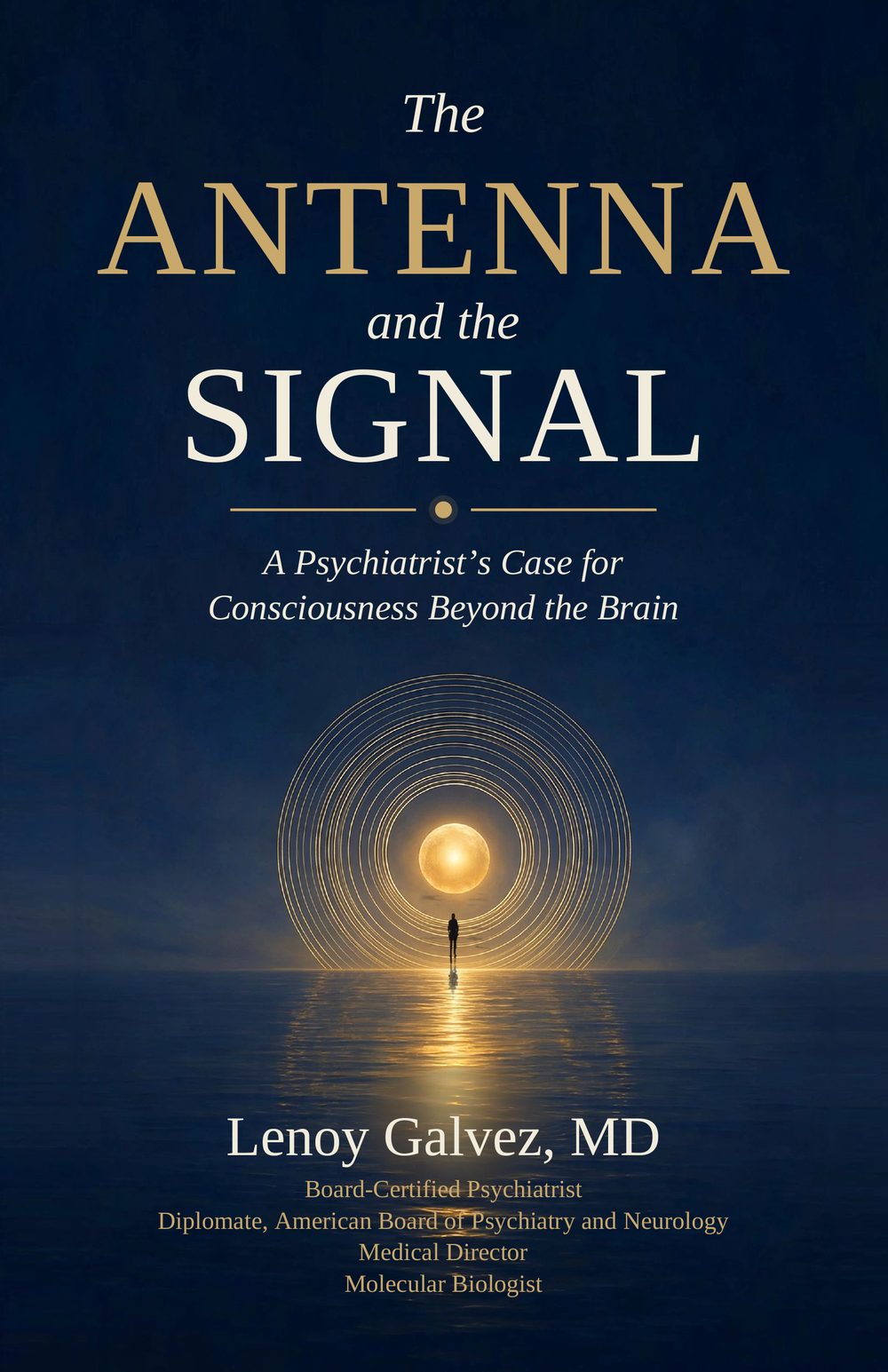
If the brain tunes experience rather than generating it, mental illness can be heard differently: not as a defect in the person, but as interference in the set — static in the receiver, not a flaw in the soul. States that psychiatry once filed away as embarrassments — meditation, psychedelic experience, the reports of people who nearly died — become data again, worth a fair hearing. That is the ground this project's book stands on: consciousness is the broadcast; the brain is the set; the mind is the program playing. The Antenna and the Signal makes the case slowly, and leaves the verdict to you.