CONSCIOUSNESS GUIDES · GUIDE 02
The double-slit experiment and the observer
Imagine firing marbles, one at a time, through two slits in a wall — and discovering that each marble somehow went through both slits at once, rippling like a wave and crossing its own path. Then imagine that the moment you set up a detector to catch it in the act, every marble starts behaving like an honest marble again. That is not a parable. It is one of the most replicated results in quantum physics, and it has never stopped being strange.
These guides are love letters with footnotes. Each one begins with the wonder — the scene that stops you — then slows down and separates what was actually observed from what is still argued about, and marks where interpretation — including this project's own lens — takes over from data. Consciousness is the deepest open question in science; these pages treat it with awe and with restraint.
EVIDENCE REVIEW
OCTOBER 18, 2026
What was actually observed
Here is the experiment, slowly. Physicists send tiny particles — electrons, atoms, even whole molecules — one at a time toward a barrier pierced by two slits, with a screen behind it. If the particles were simply tiny balls, the screen would collect two piles, one behind each slit. Instead, left unwatched, the screen slowly builds the striped pattern of interfering waves: the signature of something that passed through both slits and crossed itself, the way ripples meeting on a pond weave bright and dark bands. Each particle lands as a single dot — yet the pattern only makes sense if every particle somehow explored both routes.
Then comes the turn. Place a detector at the slits — any device that records which path each particle took — and the stripes vanish. The dots now pile up exactly as tiny balls would. Nothing in this requires a human being, or a mind: a recording device is enough. The pattern, and its disappearance under measurement, are facts, replicated for over a century; every interpretation of quantum mechanics, however wild, has to accommodate them. You can run the experiment yourself in the interactive version on this page.
Where the agreement ends
Ask what 'measurement' really is — why an open catalog of possibilities becomes one definite event — and the agreement ends. Physics predicts that moment with total precision — and still argues about what it means. The mainstream view treats the outcome as effectively random and gives consciousness no role whatsoever. A minority tradition once thought otherwise: John von Neumann traced the chain of measurement all the way to the observer's mind, and Eugene Wigner briefly wondered whether consciousness itself completes the act. That idea never won the field, and it is not established science. What is established is the silence beneath the mathematics: nobody knows why there is an outcome at all.
One careful step further
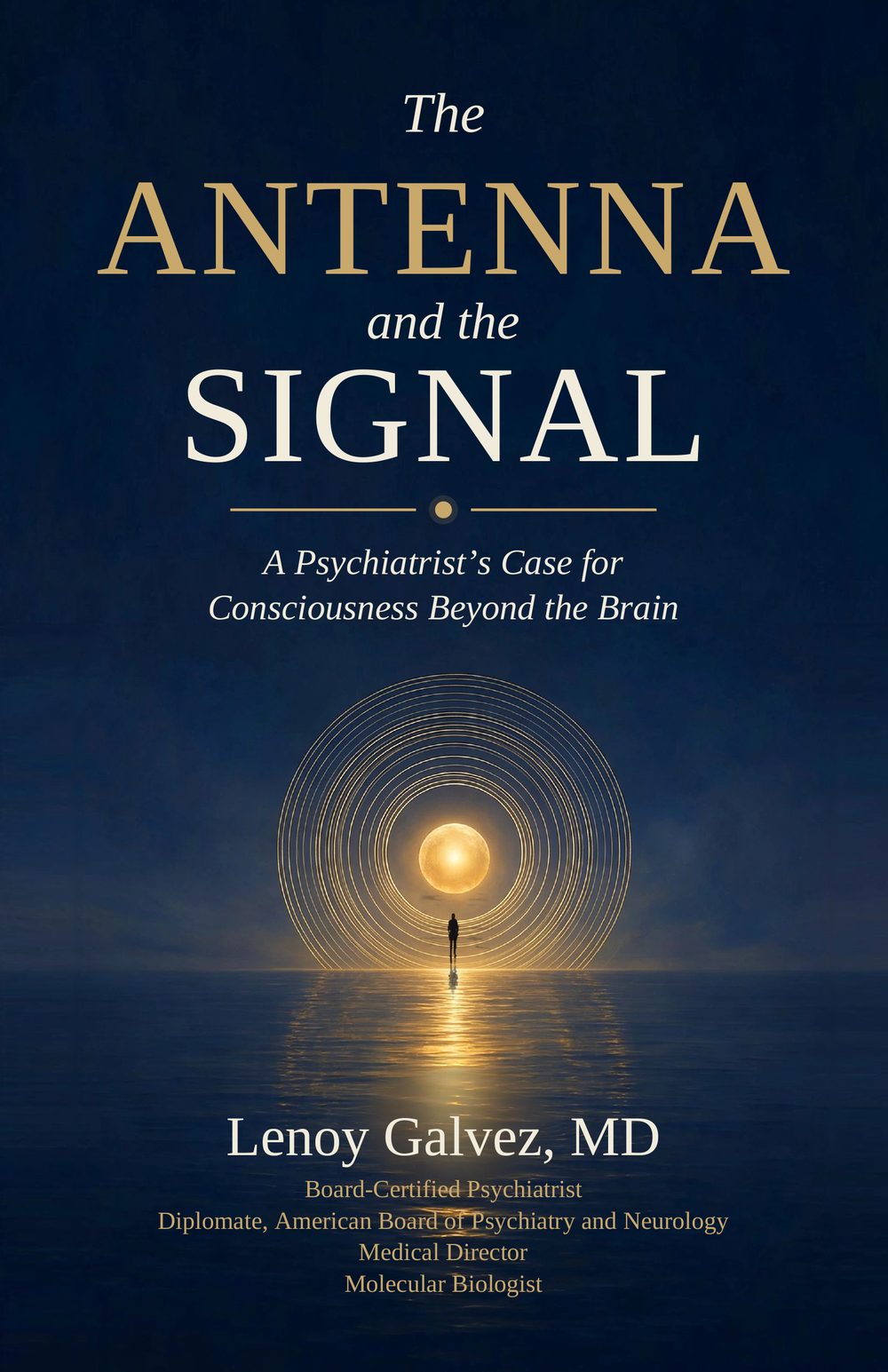
This project takes one step past the physics — and labels it plainly, as interpretation, not physics. It is the book's thesis in miniature: with no observer, everything remains all possibilities at once; with an observer, one possibility becomes real, filtered through the observer's own structure — biology, history, a lifetime of conditioning. Physics has not proved that; the boundary is stated, not blurred. But hold the picture up to a human life and it is hard to put down: reality offers the full catalog, and a life is the track that plays. If the filter helps choose the track, then changing the filter — through treatment, through practice, through a shattering experience — is not self-deception. It is a different selection from the same vast catalog. That is why an experiment in physics sits at the center of a psychiatrist's book.