STORIES · STORY 06
The man with almost no brain
A mathematics student with an IQ of 126. First-class honors. A completely normal life. And almost no brain. In 1980, a campus doctor sent a bright young student for a brain scan out of pure curiosity. What came back should have been impossible.
These stories are cases with footnotes. Each one begins with the wonder — the person, the moment that does not fit — then slows down and separates what was actually documented from what is still argued about, and marks where interpretation — including this project's own lens — takes over from data. Every story here first appeared as a short video in this project's reels; these pages are the fuller telling, at reading pace.
EVIDENCE REVIEW
OCTOBER 27, 2026
The scan that shouldn't exist
The case comes from the work of John Lorber, a neurologist at the University of Sheffield who studied hydrocephalus — the condition in which cerebrospinal fluid builds up inside the skull. It was reported by science writer Roger Lewin in the journal Science in 1980. In this student, some 95 percent of the cranium was fluid — just a thin shell of tissue where a brain should be. And yet there he was: doing mathematics, living his life, thinking his thoughts, at a level most intact brains never reach.
Lorber described more cases in the same direction — people with drastically reduced brain tissue living ordinary, sometimes exceptional, lives. The finding was contested at the time, and it has never been fully absorbed since. Brains are plainly plastic; they reorganize. But reorganization is a word, not an explanation, when nearly all of the organ is missing and the mind is intact.
The question it raises
If the mind is simply what the brain makes — thought manufactured by tissue, the way a factory's output is fixed by its machinery — then removing almost all of the machinery should leave almost nothing. This case leaves an honors mathematician. The receiver model reads it the other way: if the signal was never stored in the set to begin with, then even a radically reduced receiver might, sometimes, still tune. The case does not settle the argument. It refuses to let the argument be settled cheaply.
Watch the story
This story first appeared as a short video in this project's reels — find it among the project's Shorts. Watch the reels on YouTube
Go deeper: the brain as receiver — the antenna idea
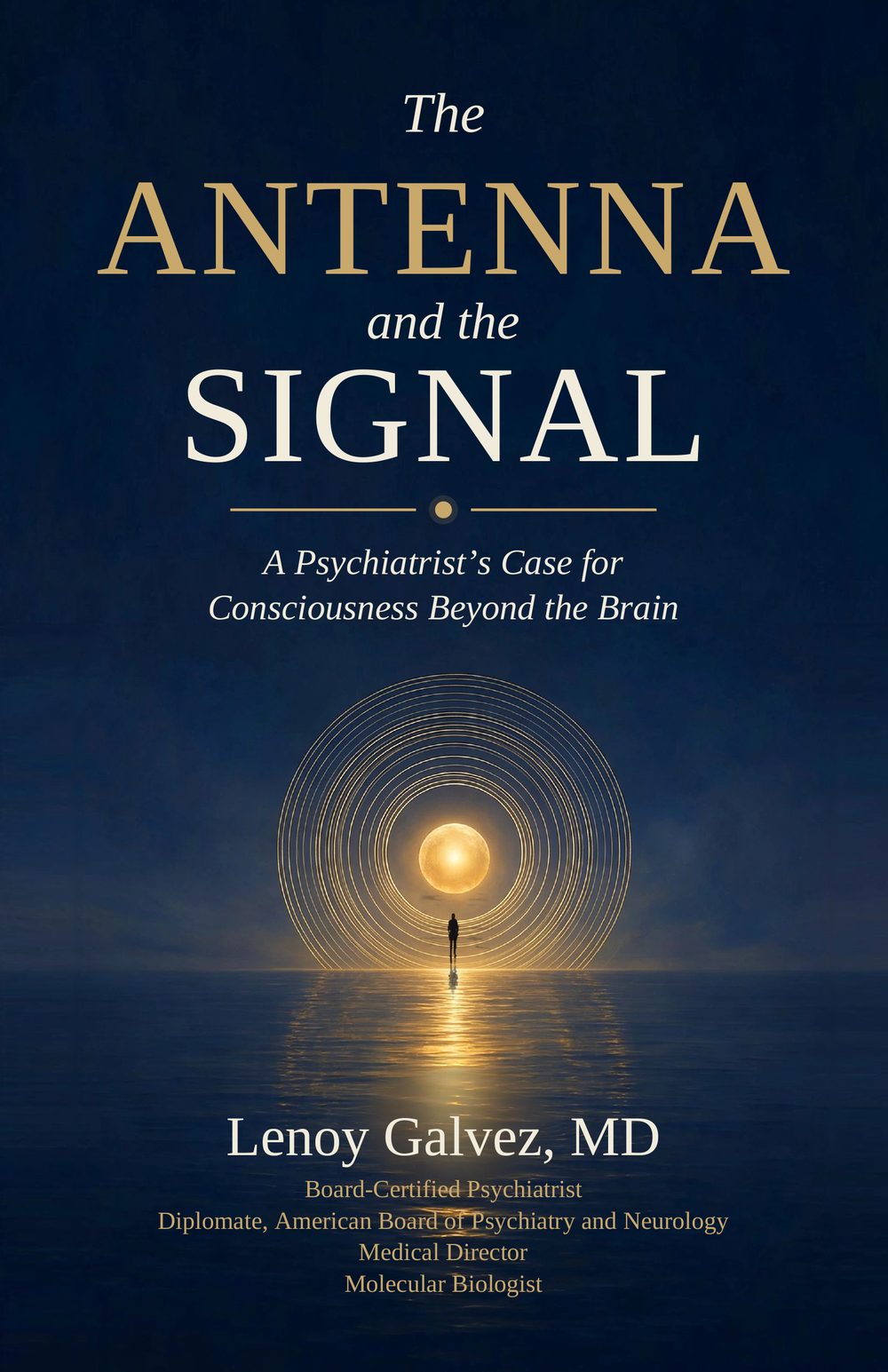
Stories like this one run through The Antenna and the Signal, this project's book. About the book